
BMW E36 M3
The M3 that stopped being a homologation special and became a way of life.
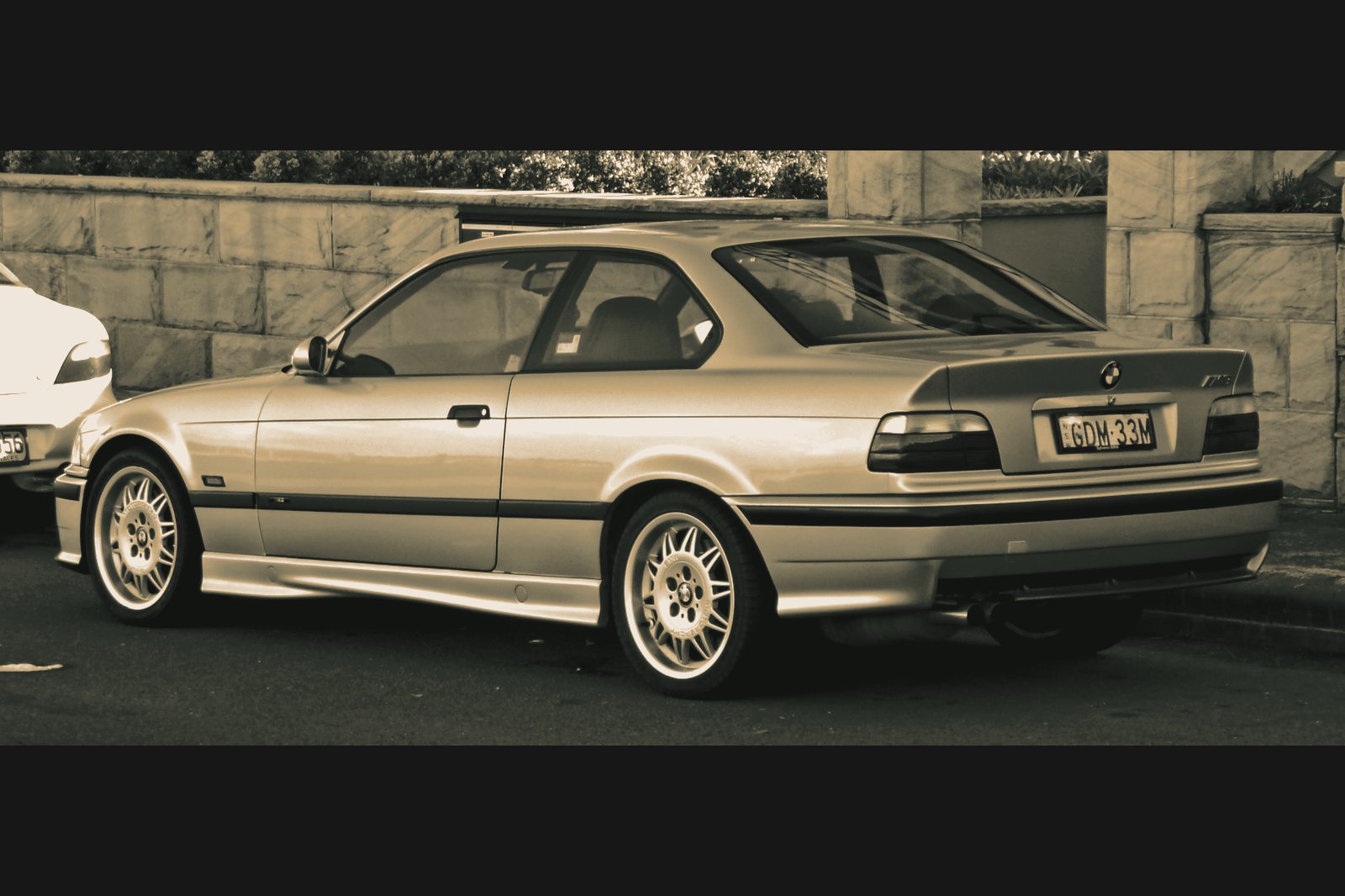
Photograph by OSX · Public domain · Wikimedia Commons · Full credits
| Chassis | E36 |
|---|---|
| Years | 1992–1999 |
| Engine | S50B30 / S50B32 I6 |
| Output | 286 hp (3.0) · 321 hp (3.2) |
| Weight | ≈1,460 kg |
The useful one
The E30 M3 was an argument. Built to satisfy Group A homologation, it wore its purpose on the outside: boxed arches, a raked rear screen, a four-cylinder that revved like a motorcycle engine. When BMW replaced it in late 1992, the enthusiast press braced for another homologation special and got something else entirely — a smooth, six-cylinder, relatively civilised coupé with a body that looked very much like the 325i parked next to it. The verdict at the time was that M had gone soft. Thirty years later, that verdict looks less like criticism and more like a description of the E36's usefulness.
Start with the engine, because it is the reason the car exists. The European launch car used the S50B30: 2,990 cc, 286 horsepower at 7,000 rpm, and BMW's first application of VANOS variable valve timing on the intake camshaft. That was a serious number for a naturally aspirated production straight six in 1992 — enough to embarrass cars costing twice as much, delivered with a flat torque curve that made it drivable in a way the E30's S14 never quite was. In 1995 the engine was reworked into the S50B32: 3,201 cc, double VANOS, 321 horsepower at 7,400 rpm and 350 Nm, mated to a six-speed Getrag gearbox. It cleared 100 horsepower per litre without forced induction, from a road car with a warranty.
North America got neither. The federalised cars ran the S50B30US in 1995 and the S52B32 from 1996, both rated at 240 horsepower, both fitted with a cheaper cylinder head and softer cams. It is the great grievance of American E36 ownership and it is also, indirectly, why the chassis became the default club-racing platform in the United States: the cars were cheap, the engines were understressed, and the parts supply was effectively infinite.
Why it still works
What makes the E36 a trackday car rather than a museum piece is the arithmetic. Around 1,460 kilograms, near-perfect balance, a naturally aspirated engine that likes being held near the limiter, and a rear subframe that — reinforced properly, which every serious car now has been — takes abuse indefinitely. It is quick enough to be interesting on a wet Tuesday and slow enough to be legible.
It is also the last M3 that is still genuinely accessible. The E30 has become an investment; the E46 is following it; everything after weighs as much as a small van. The E36 remains the one you can buy, run, bend, straighten and enter in a regional sprint series without a spreadsheet. That is not a consolation prize. That is the whole point of the car — and the reason it opens this archive.
The E36 is the last M3 you can still bend, straighten and enter next weekend.
Issue 01 — Why it matters| Chassis | E36 |
|---|---|
| Years | 1992–1999 |
| Engine | S50B30 / S50B32 I6 |
| Output | 286 hp (3.0) · 321 hp (3.2) |
| Weight | ≈1,460 kg |
| Layout | Front engine, rear drive, 5-speed (3.0) or 6-speed Getrag (3.2) |
| Bodies | Saloon E36 · coupé E36/2 · convertible E36/2C · touring E36/3 · Compact E36/5 · Z3 roadster E36/7 · Z3 coupé E36/8 |
| US market | S50B30US then S52B32 — 240 hp, detuned for North America |
| Assembly | Munich, Regensburg and Dingolfing · Spartanburg, South Carolina from September 1994 · Rosslyn, South Africa · Z3 exclusively Spartanburg |
| Notable races | 1993 ADAC GT Cup title (M3 GTR, Johnny Cecotto) · 1993 BTCC title (318i, Joachim Winkelhock) · 1994 and 1998 STW titles (Johnny Cecotto) · Nürburgring 24 Hours overall wins 1996 and 1997 (Scheid Motorsport) · IMSA GTS-2/GTS-3 manufacturers' titles 1996, 1997, 1998 with BMW Team PTG |
Not only the M3
The M3 is the car the archive remembers. The championships were mostly won by the others — four-cylinder saloons, 2.0-litre touring cars and a pair of hand-built endurance coupés from a garage in the Eifel.
The touring cars
Germany's Super Tourenwagen Cup ran to the 2.0-litre Super Touring formula, which excluded the M3 entirely and suited the ordinary 3 Series perfectly. Johnny Cecotto took the inaugural 1994 title for the BMW Motorsport works team, and won again in 1998 in a 320i run by Schnitzer; Joachim Winkelhock took the 1995 title in between, also with Schnitzer. The 1994 car is recorded inconsistently even by BMW — BMW Group Classic labels it a 318i, while other summaries call it a 318is — and we have kept BMW's own caption rather than resolve the difference silently.
In Britain, Winkelhock won the 1993 British Touring Car Championship in a Schnitzer-run 318i, car number 22, with Steve Soper alongside him in the second car. That was BMW's second BTCC title in two years but not the same programme: Tim Harvey had taken the 1992 championship in a 318is run by Vic Lee Motorsport, and the two are routinely conflated. The E36 also carried Australian Super Touring — Tony Longhurst in 1994, Paul Morris in 1995, 1997, 1999 and 2000 — where BMWs won roughly half of all races run between 1994 and 1999.
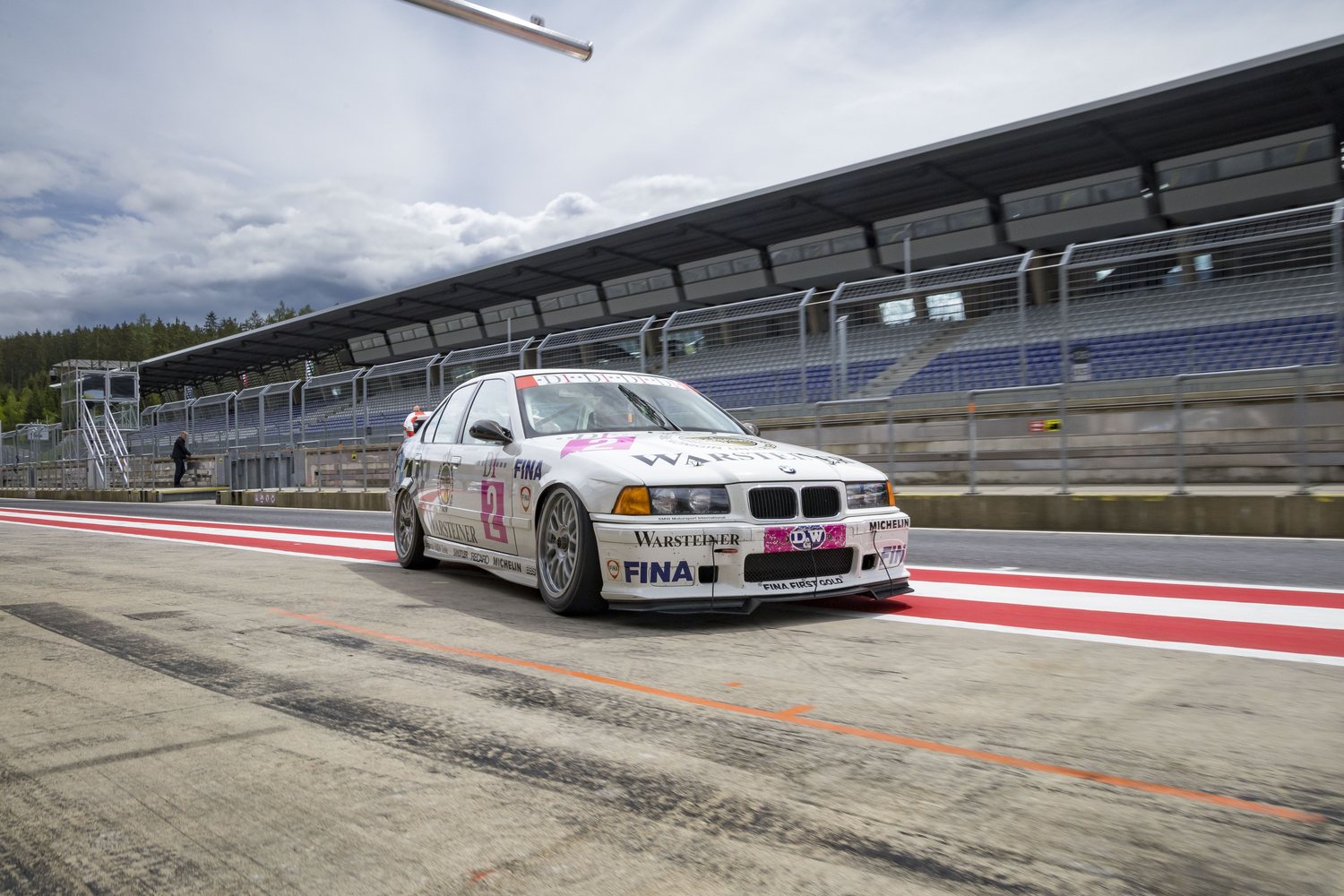
The 1994 Super Tourenwagen Cup winner. White body, magenta number roundel, Warsteiner across the screen and FINA blue down the flank — the sponsor pairing that also ran on the British and GT Cup cars. BMW photographed the surviving car in a modern pit lane, so read this as a portrait of the artefact rather than a period frame.
BMW caption: “BMW 318i (E36) STW, winner of the STW-Championship 1994”. © BMW AG, supplied via BMW Group PressClub · P90559994 · reproduced unaltered, resized only · Press terms
Two cars, two years, one hill
Johannes Scheid's team won the Nürburgring 24 Hours outright in 1996 and again in 1997. The crew lists painted on the glass identify which car is which — and explain why the second one is blue.
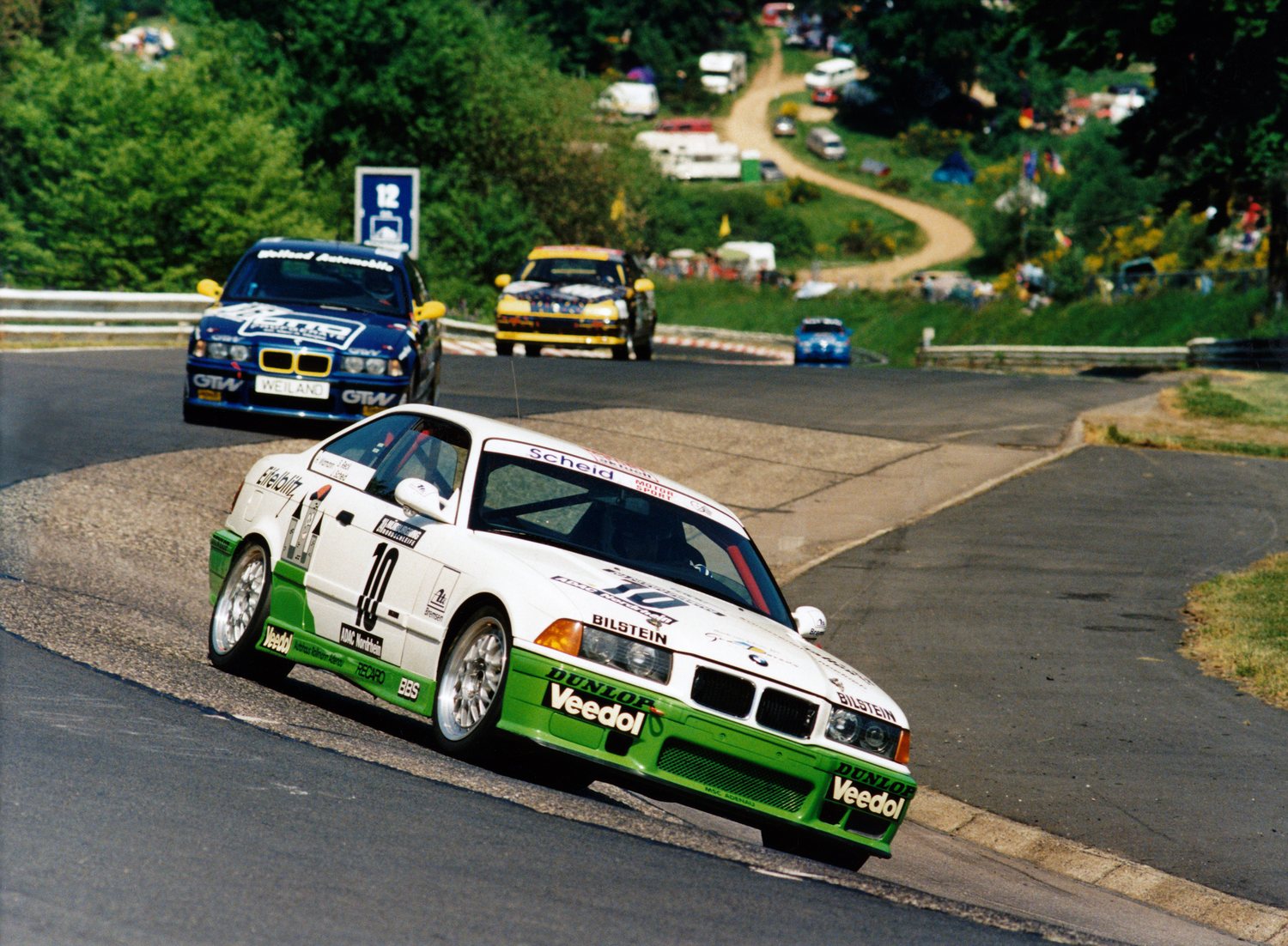
Number 10, the 1996 overall winner: white with a green lower band, Veedol on the sill, ADAC Nordrhein beneath the door number, and the Eifelblitz castle mascot on the front wing. The names above the door read H. Widmann, S. Reck and J. Scheid — the 1996 crew. BMW captions this whole set 1997, which is the year of the shoot rather than of the car; we have gone with the names painted on the glass.
BMW caption: “Nürburgring. Johannes Scheid, BMW M3 E36 „Eifelblitz“, Nürburgring 24 Hours, Nordschleife (1997)”. © BMW AG, supplied via BMW Group PressClub · P90401202 · reproduced unaltered, resized only · Press terms
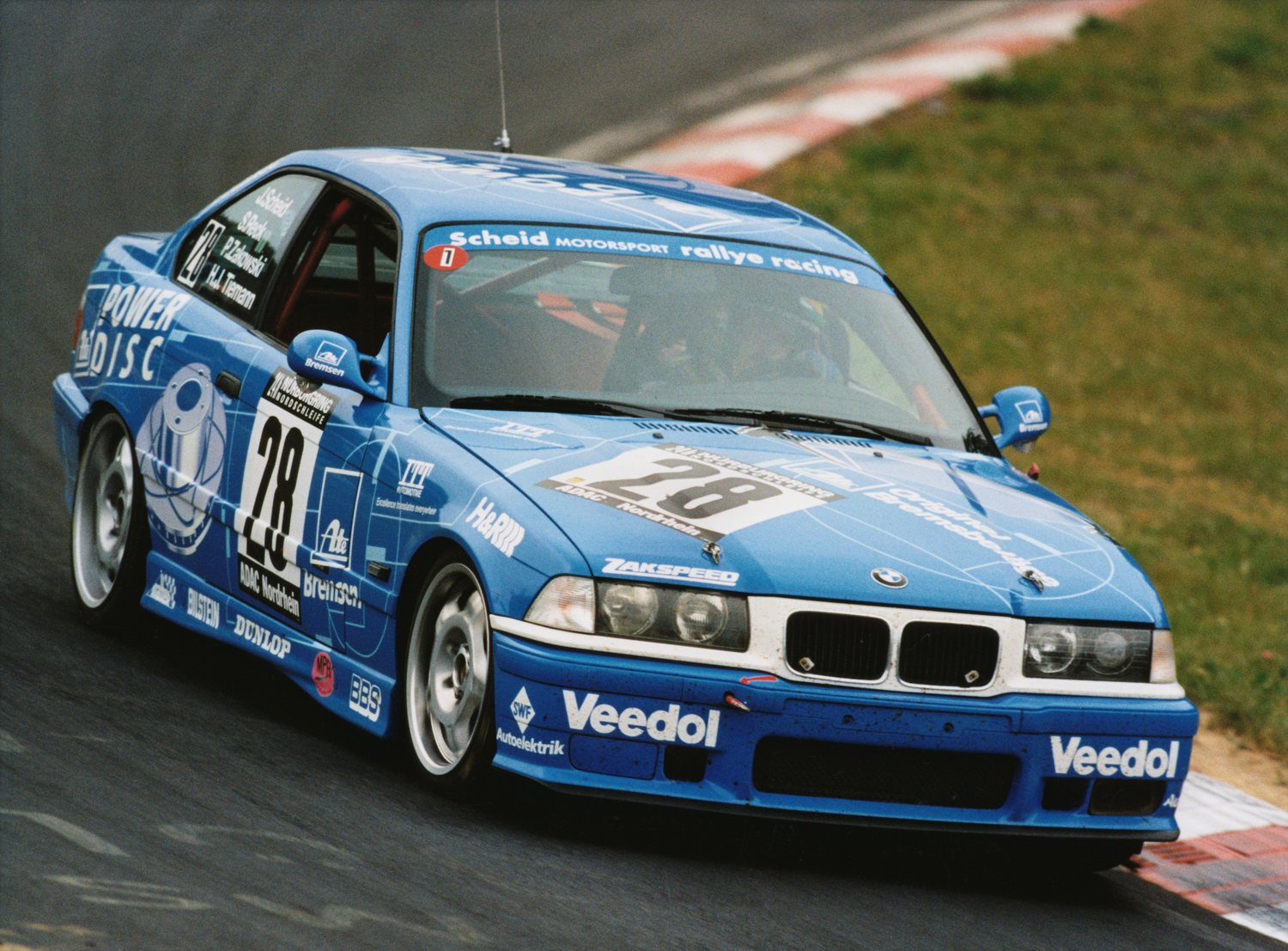
Number 28, the 1997 overall winner: mid-blue with white number panels and a white sill stripe, an ATE brake-disc graphic across the flank. The crew list adds a fourth name — J. Scheid, S. Reck, P. Zakowski and H.-J. Tiemann.
BMW caption: “Nürburgring. Johannes Scheid, BMW M3 E36 „Eifelblitz“, Nürburgring 24 Hours, Nordschleife (1997)”. © BMW AG, supplied via BMW Group PressClub · P90401206 · reproduced unaltered, resized only · Press terms
The 1996 win is the one the record books mark. Scheid shared the car with Hans Widmann and Sabine Reck — later, and better known as, Sabine Schmitz — making her the first woman to win the race outright. The following year the same team won again with Peter Zakowski and Hans-Jürgen Tiemann added to the crew.
Our BMW M3 E36 was mainly white and, in my opinion, looked pretty naked.
Johannes Scheid, interviewed by BMW GroupScheid's complaint has always read as a throwaway line. Set against the photographs it becomes a chronology: the car he is describing is the white number 10, and the car that replaced it was painted blue. We are inferring the sequence from the liveries and the painted crew lists rather than from a stated cause, but the two frames make the change difficult to miss.
North America — Prototype Technology Group
In the United States, BMW North America handed the programme to Tom Milner's Prototype Technology Group in Virginia. PTG's first two cars turned up at Daytona in February 1995 looking close to showroom stock and took pole in class. What followed was a decade-defining run: the IMSA GTS-2 manufacturers' title in 1996, BMW's first since 1981, off the back of four wins; a clean sweep of manufacturers', team and drivers' honours in GTS-3 in 1997 with eight wins and Bill Auberlen as champion; and further titles in 1998 across IMSA GT3 and the USRRC, with class victories at both Daytona and Sebring in consecutive years. The team moved to the E46 in 2000.
Europe had already made the case in 1993. BMW Motorsport built four E36 M3 GTRs — three race cars and a single road-going homologation example — for the ADAC GT Cup, and they won six of the eight races, Cecotto taking the title with Kris Nissen second.
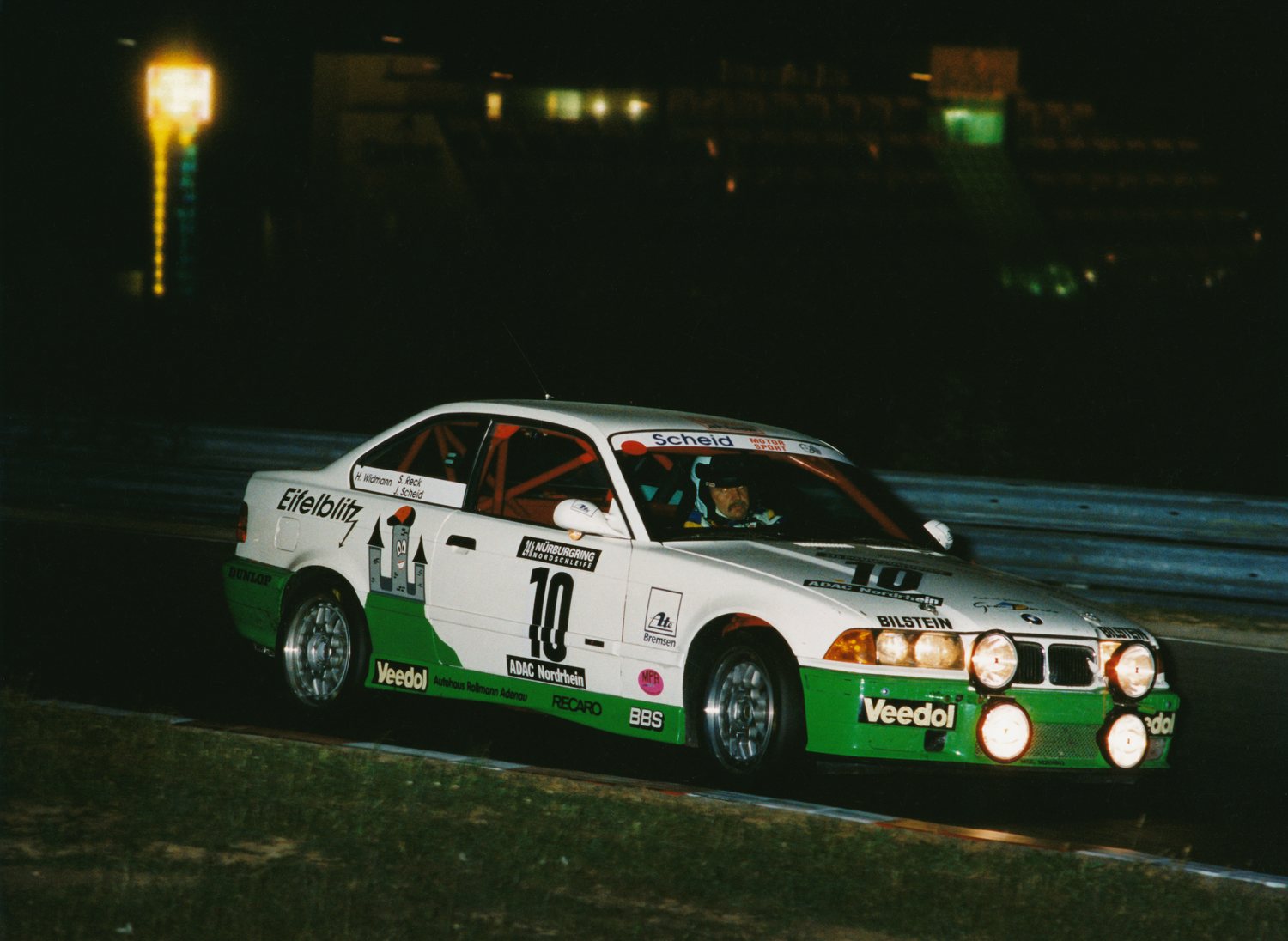
The same number 10 at night, where the Nordschleife is actually decided. The door reads Autohaus Rollmann Adenau — a local dealership on a car that beat factory entries — and the crew list is again the three 1996 names.
BMW caption: “Nürburgring. Johannes Scheid, BMW M3 E36 „Eifelblitz“, Nürburgring 24 Hours, Nordschleife (1997)”. © BMW AG, supplied via BMW Group PressClub · P90401205 · reproduced unaltered, resized only · Press terms
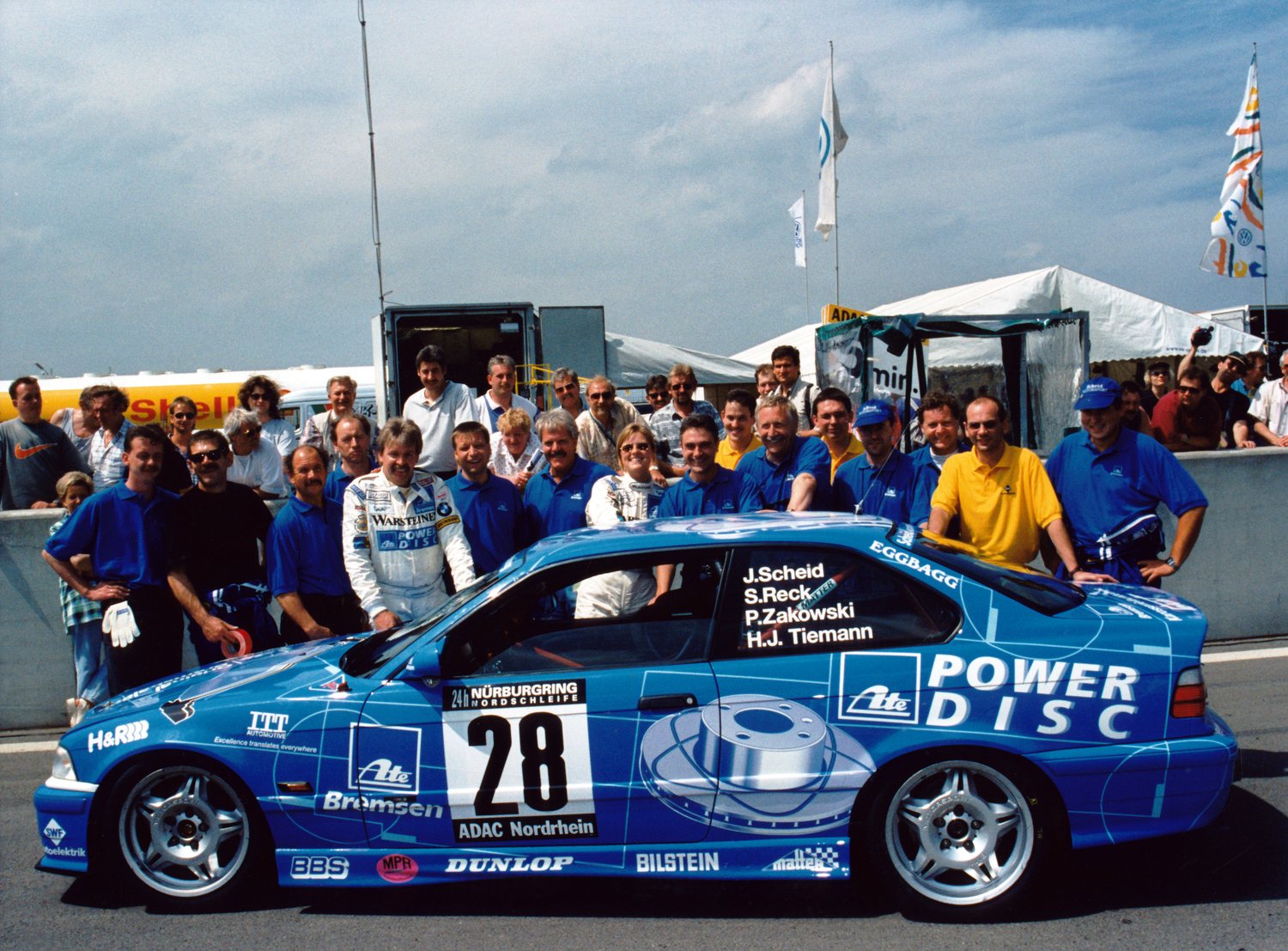
The 1997 crew with number 28. The rear quarter carries a brake-disc graphic for ATE, which is a fair summary of what a 24-hour race on that circuit consumes.
BMW caption: “Nürburgring. Johannes Scheid, BMW M3 E36 „Eifelblitz“, Nürburgring 24 Hours, Nordschleife (1997)”. © BMW AG, supplied via BMW Group PressClub · P90401199 · reproduced unaltered, resized only · Press terms
The GT Cup car
The car the FINA livery study is drawn from, photographed in period at the height of its season.
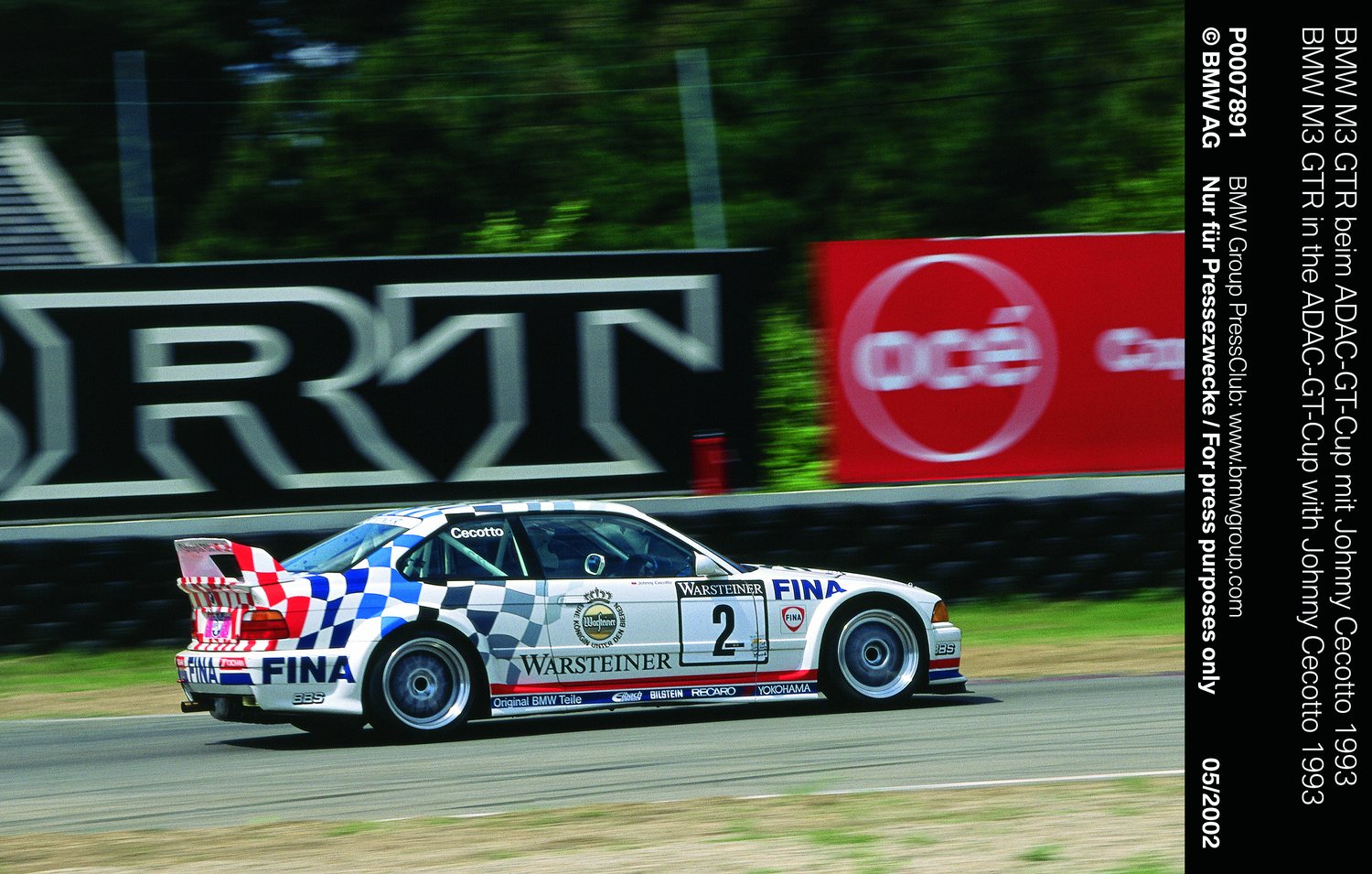
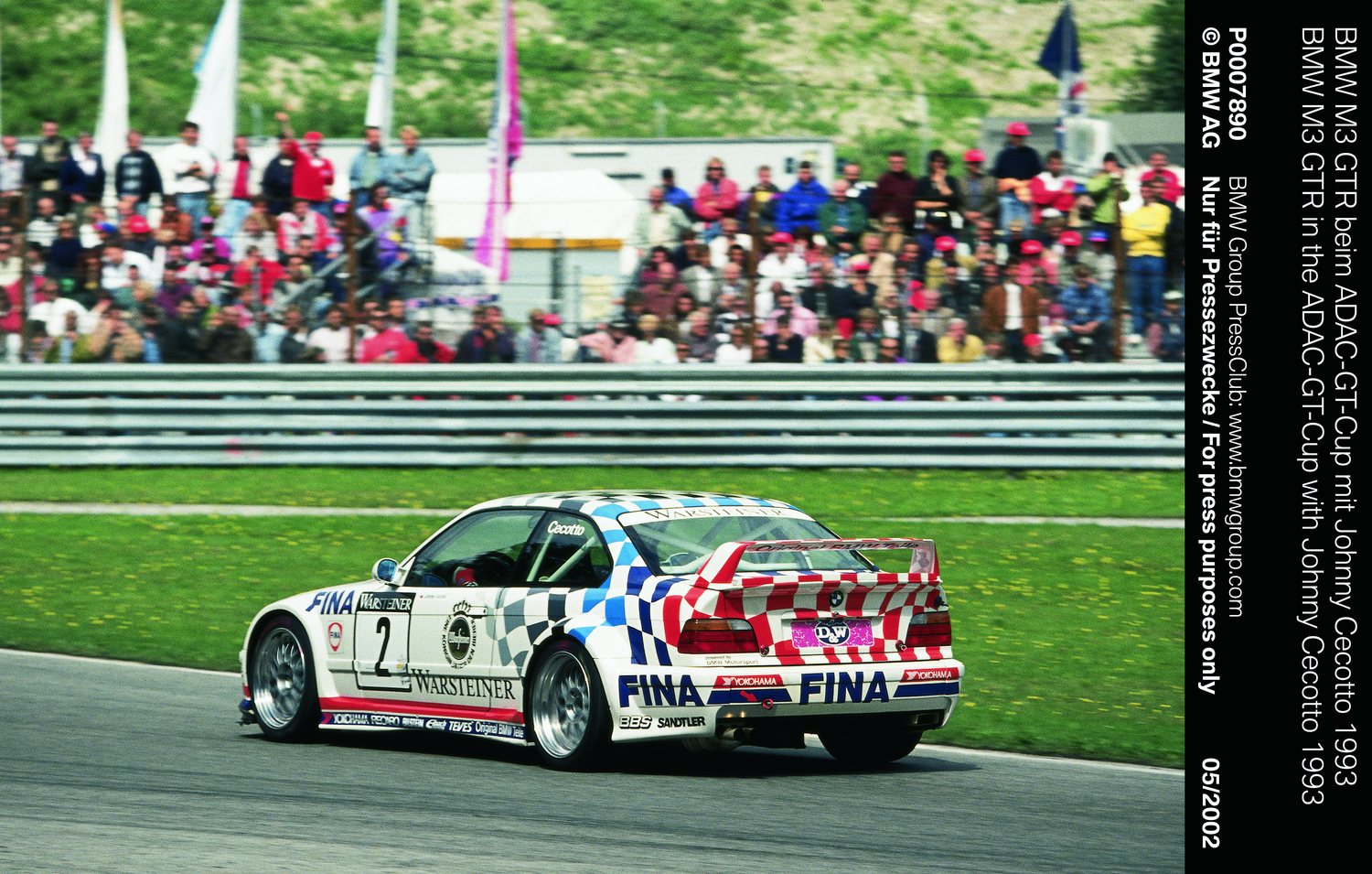
Car number 2, the 1993 ADAC GT Cup winner: Johnny Cecotto for BMW M-Team Warthofer, under FINA and Warsteiner. The side profile shows the arrangement the livery study describes — nose, bonnet, front wings and front doors left plain white, the distorted checkered field starting aft of the B-pillar and breaking apart as it runs to the tail. The rear three-quarter shows where it ends up: red and blue squares scattered across the boot lid and rear wing, still legible as a flag at racing speed. BMW released these two frames in 2002 with the caption printed into the right-hand edge of the file. We have left it there. Cropping it off would put us outside the terms we hold them under, and the bar is a fair record of what a press photograph actually is.
© BMW AG, supplied via BMW Group PressClub · P0007891 · P0007890 · reproduced unaltered, resized only · Press terms
Spartanburg, South Carolina
The E36 is the generation that took BMW out of Germany. The first car built at the company's new American plant was a 3 Series, and it was chosen precisely because it was unremarkable.
BMW began looking for a North American site in 1989 under Helmut Panke, considered more than two hundred locations, and narrowed the list to Omaha, Nebraska and the South Carolina upstate. Governor Carroll Campbell steered the company inland from Charleston on hurricane risk; Eberhard von Kuenheim wanted a site beside an interstate, visible from it, and close to an airport. Spartanburg satisfied all three. The state bought the 900-acre site for 36.6 million dollars and spent about 90 million more on infrastructure, assembling the land from some 250 households without resorting to eminent domain.
The announcement came on 23 June 1992, groundbreaking that September, and construction took twenty-three months. Reported investment for the first phase does not agree across sources: contemporary wire reporting put it at 250 to 300 million dollars, BMW's own press material says 400 million, and the plant's current site says 600 million. We quote the range rather than pick a figure. Around 570 people were hired in the first round from roughly 100,000 applications; the plant passed 11,000 employees by 2024, on cumulative investment since 1992 of about 14.8 billion dollars.
One claim needs handling carefully, because it is usually overstated. Spartanburg was BMW's first full production plant outside Germany — BMW's own wording. It was not BMW's first manufacturing presence outside Germany: Rosslyn in South Africa had been assembling cars since 1968 and was BMW-owned from 1973. The distinction is between assembly and full production, and it is worth keeping.
The E36 M3 itself was never an American car. M3 production sat at Regensburg, with a small number of right-hand-drive cars from Rosslyn. What Spartanburg did build, and built for the entire world, was the Z3.
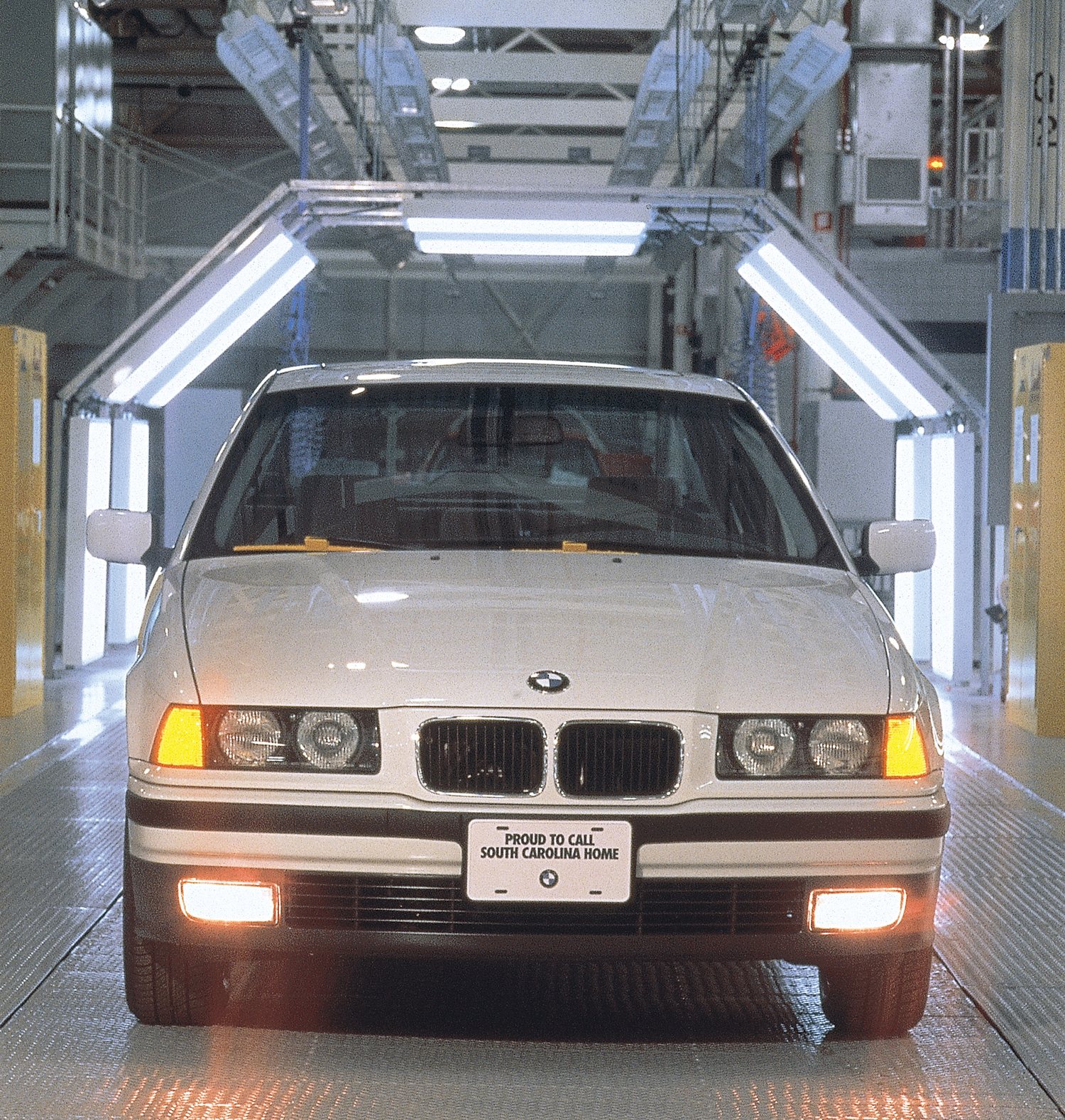
The first vehicle built at Spartanburg, September 1994 — a 318i saloon, picked because it was, in the plant's own phrase, a known quantity. Every associate on site signed it, and it was driven onto a stage that November by associate number five, Sky Foster.
BMW caption: “The first vehicle manufactured at the Spartanburg plant (USA): a third-generation BMW 3 Series (E36) (1994)”. © BMW AG, supplied via BMW Group PressClub · P90627181 · reproduced unaltered, resized only · Press terms
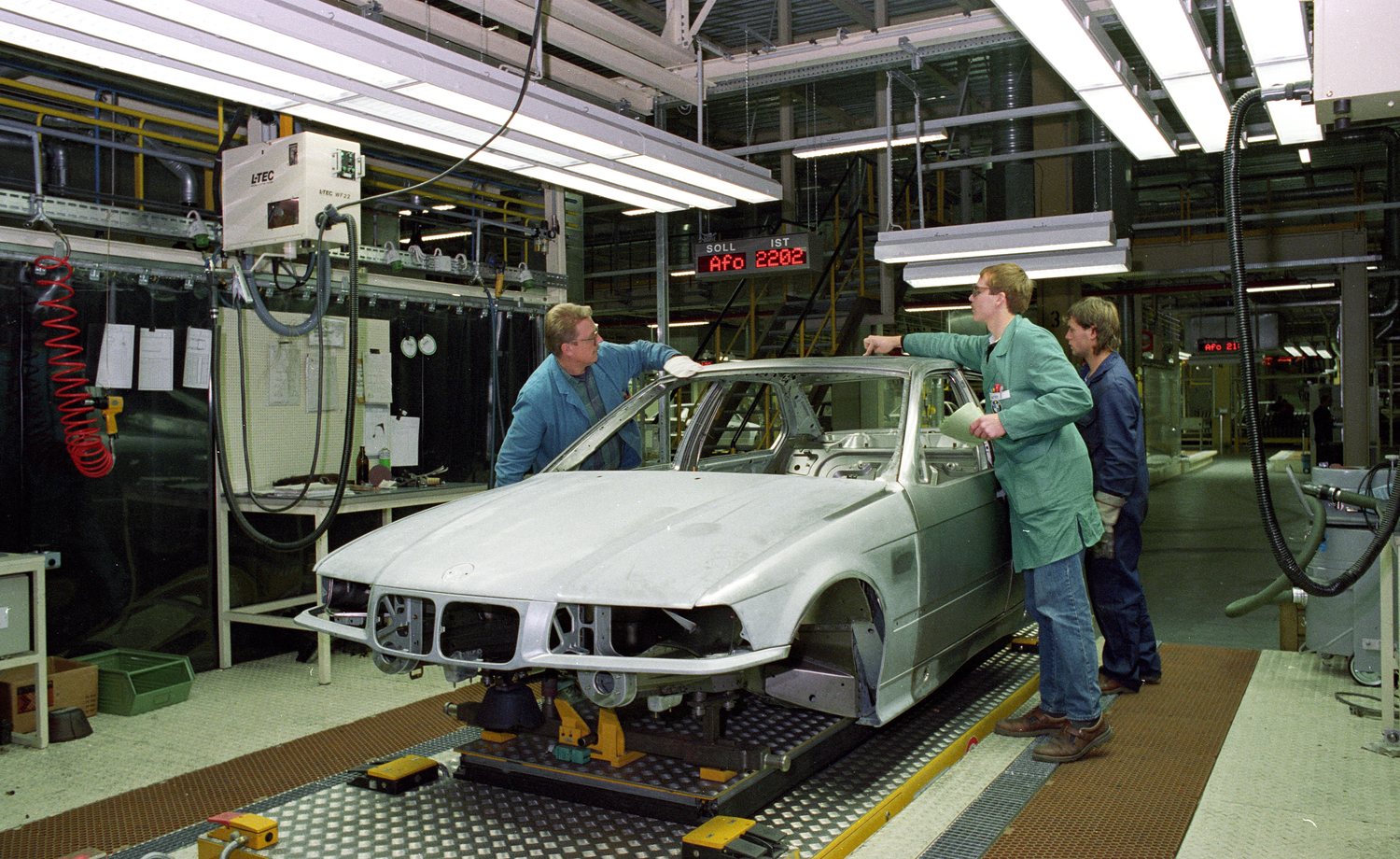
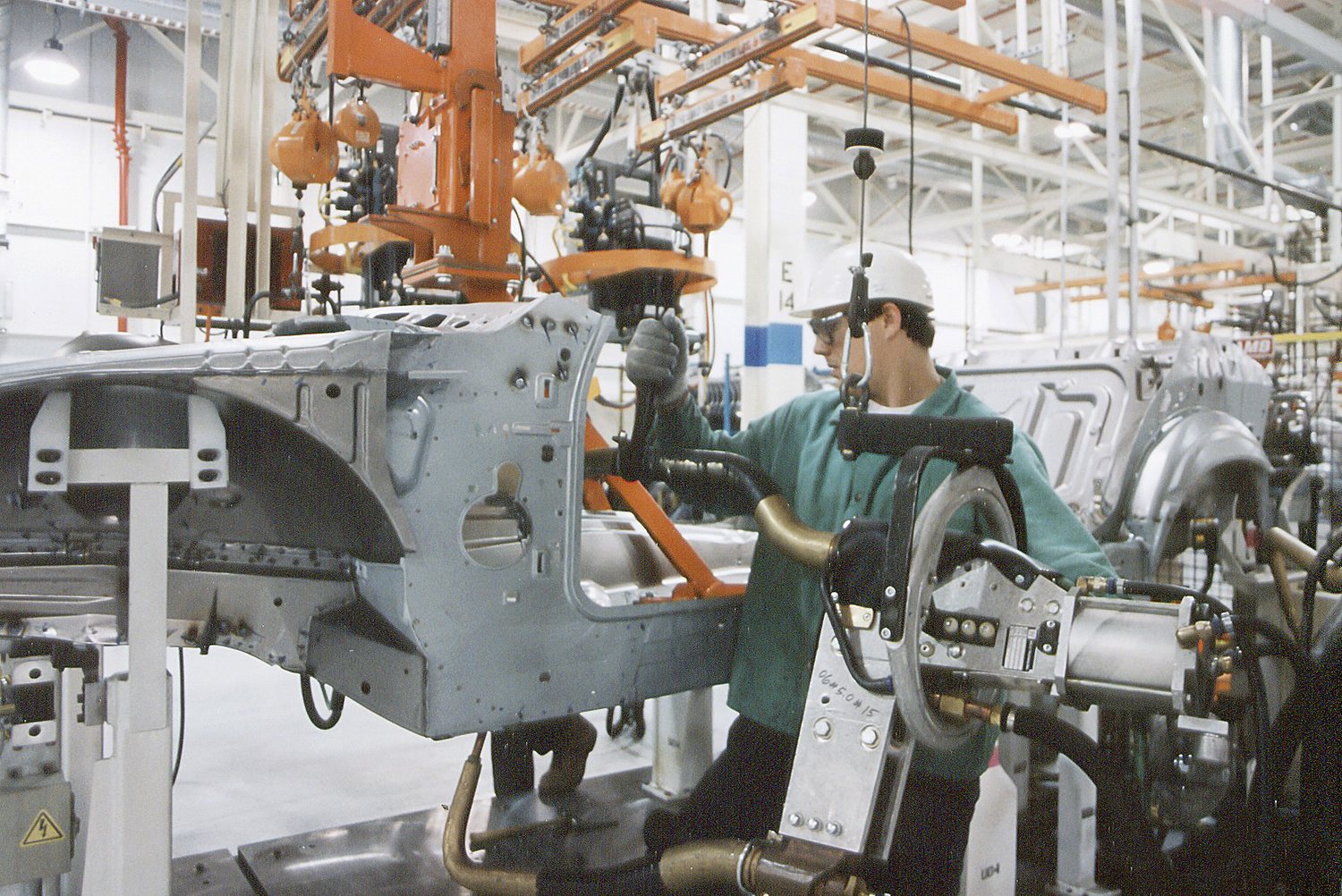
Regensburg, 1990: the E36 bodyshop two years before the American announcement, in the plant that would build every M3. Spartanburg, 1994: body construction on the same generation of car, on another continent, four years later.
© BMW AG, supplied via BMW Group PressClub · P90627175 · P90627182 · reproduced unaltered, resized only · Press terms
The ones you rarely see
E36 is a family, not a car. It covers six body styles, a homologation special built in British Racing Green only, a one-off hot hatch, and a roadster that outsold the M3.
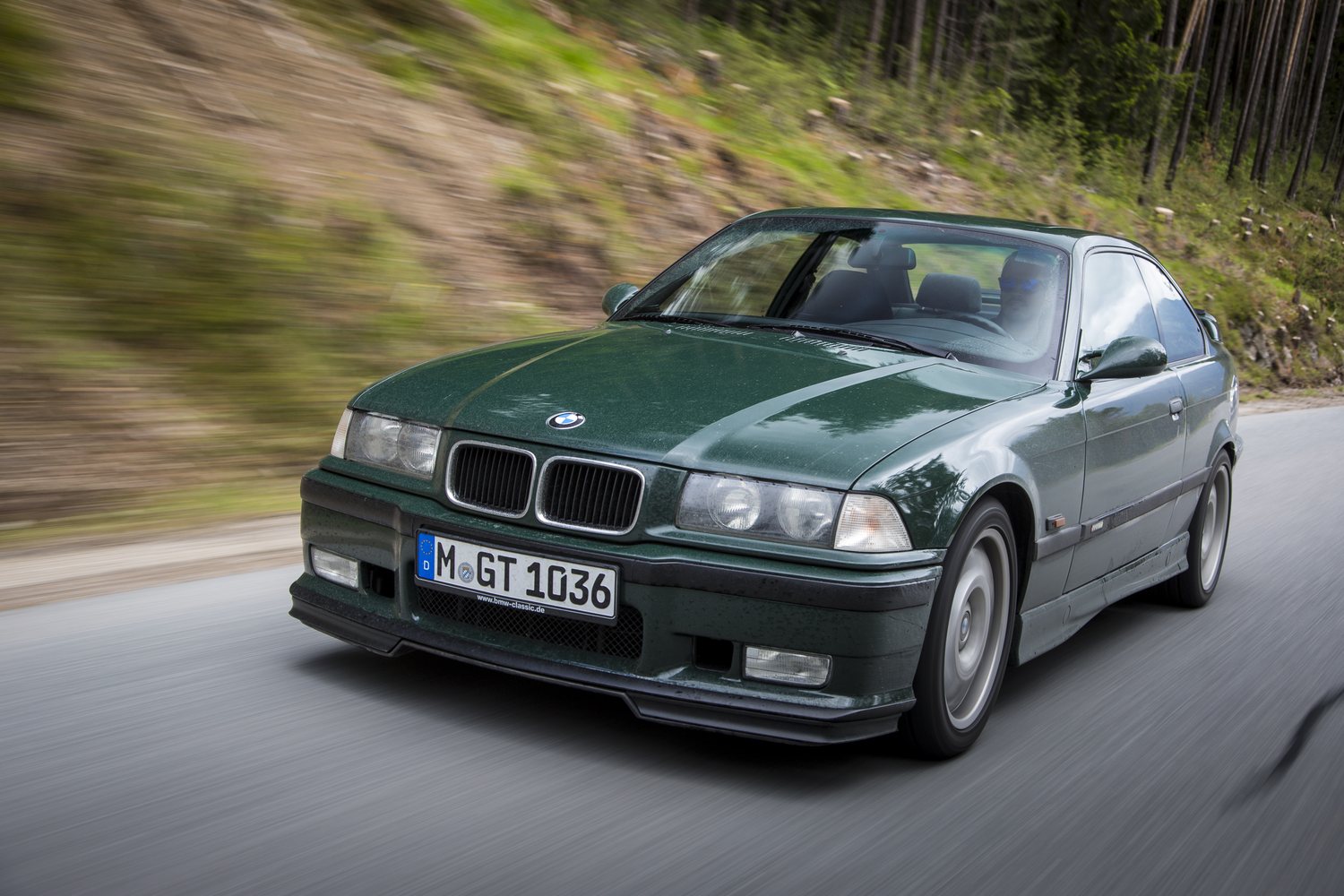
The M3 GT, 1995: 356 cars including five pre-production examples, every one in British Racing Green, paint code 312. Aluminium doors, an adjustable front splitter and a raised twin-element rear wing.
BMW caption: “The BMW M3 GT Coupé (E36) (09/2016)”. © BMW AG · Gudrun Muschalla, supplied via BMW Group PressClub · P90233355 · reproduced unaltered, resized only · Press terms
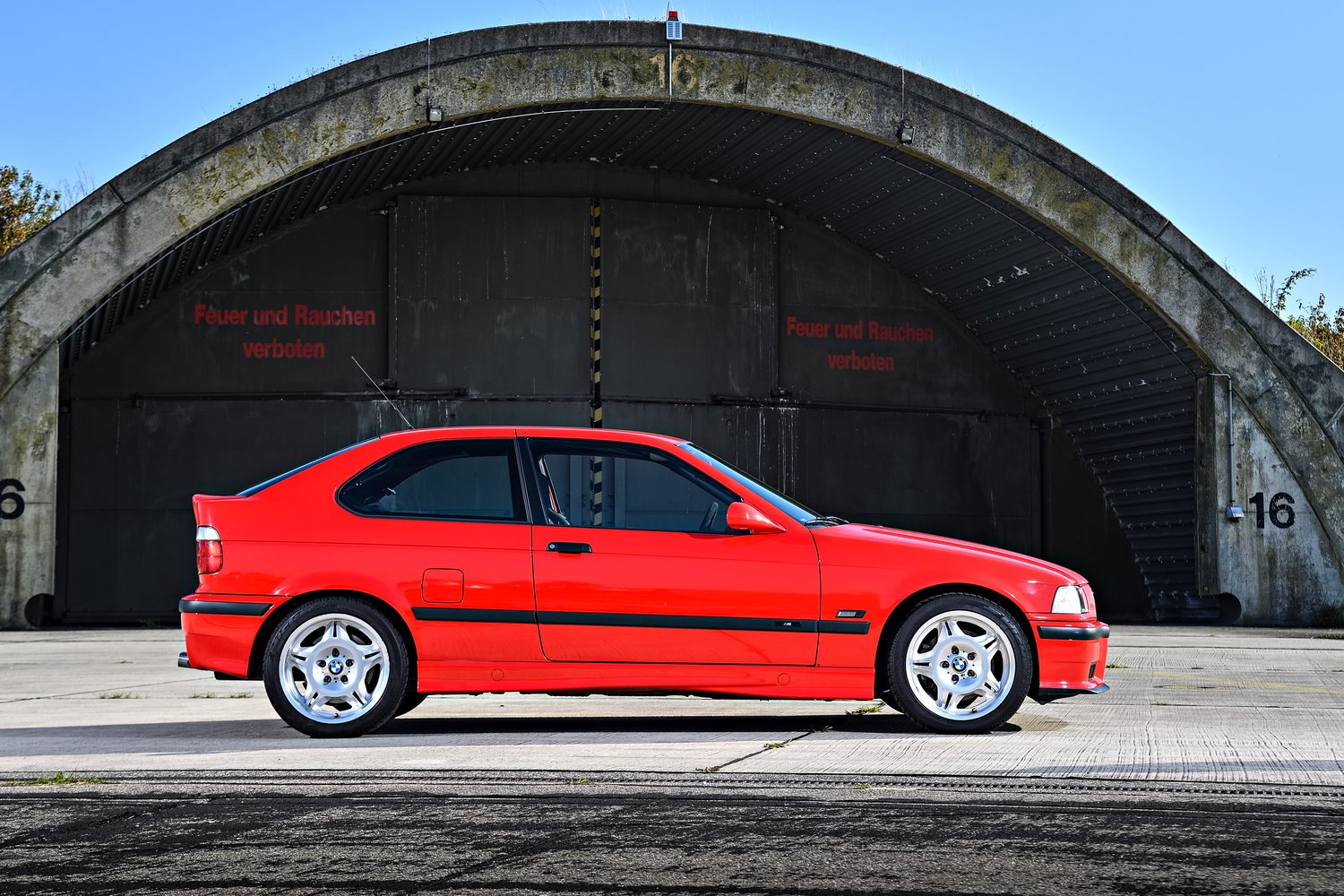
The M3 Compact — a single hand-built car, 1996, made for the fiftieth anniversary of Auto Motor und Sport. It was never sold. Two German-language accounts claim a second example; BMW M describes one, and we follow BMW M.
BMW caption: “The BMW M3 Compact (E36) (09/2016)”. © BMW AG, supplied via BMW Group PressClub · P90236495 · reproduced unaltered, resized only · Press terms
The GT was the homologation car for European GT racing and the sharpest road E36 M3 BMW made. Its S50B30 ran six individual throttle bodies and the 3.2's intake manifold for 295 horsepower at 7,100 rpm and 323 Nm, good for 5.9 seconds to 100 km/h and 275 km/h derestricted, in a shell some 20 to 30 kilograms lighter than standard. It was left-hand-drive for Germany and Europe at DM 91,000, with fifty right-hand-drive cars for the United Kingdom.
America got its own version of the idea. The M3 Lightweight — 126 cars built between August and October 1995, all in Alpine White, paint code 146, under 1,350 kilograms, with the tri-colour M chequered decor on the flanks — kept the federalised engine and its 240 horsepower. The weight came out instead: no air conditioning, no radio, thinner glass.
Below the M cars, the 3 Series Compact was its own chassis code, E36/5, built from 1994 to 2000. It is the odd one out mechanically: rather than the E36's Z-axle it kept the E30's semi-trailing-arm rear suspension, a decision it shared with the Z3. The touring, E36/3, arrived in November 1994 and ran to 1999 for 105,606 cars.
Then the Z3, and a correction worth making because the mistake is so common. The Z3 is an E36 derivative — E36/7 as a roadster, E36/8 as the coupé — built exclusively at Spartanburg for the world market from September 1995 to July 2002, 297,088 cars, around forty per cent of them sold in the United States. The Z4 that replaced it is not an E36 car at all: it is E85 and E86, then E89, then G29. If you have seen the Z4 described as an E36 variant, that is wrong, and this archive said so.
Sources — BMW M3 (Wikipedia); BMW M, the E36 M3 GT; BMW M, a unique BMW M3 Compact; Supercar Nostalgia, BMW E36 M3 3.0 GT; BMW Group PressClub, Plant Spartanburg history (PDF); BMW Group Plant Spartanburg; UPI, 23 June 1992; Los Angeles Times, 24 June 1992; BMW Group, Johannes Scheid interview; Nürburgring 24 Hours results; Racing Sports Cars, Nürburgring 1994; PTG Racing, BMW M3 programme; Bring a Trailer, 1998 PTG M3 IMSA car.
Photography — the ten colour photographs in this issue are BMW Group press material, reproduced unaltered under press terms and credited individually beneath each plate. See Press terms for the basis on which they appear.
Colour studies
E36 M3 — the American campaign
Blue and red swept into a forward chevron on white — the works colours restated in an American accent.
E36 M3 — the waving flag
A checkered flag caught mid-ripple. Two-thirds of the shell left empty so the last third can do all the talking.
E36 318i — the STW champion
A magenta disc on a white shell, held forward of centre. The loudest single element in the archive and the most disciplined use of one.
E36 M3 — the blue Eifelblitz
Two white number panels on a mid-blue shell. An endurance livery designed to be read at night, from a distance, by a marshal who has been awake for nineteen hours.
E36 M3 — the white Eifelblitz
A green lower third rising toward the nose, and nothing else. The car that won the Nordschleife outright, dressed like a dealership demonstrator.
One email per issue
Styled only — nothing is submitted anywhere.